
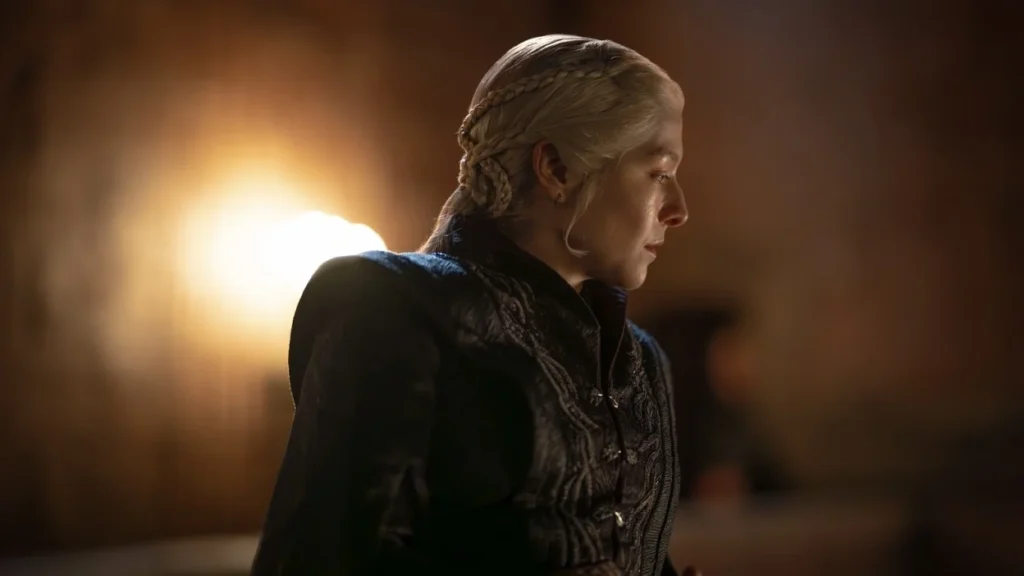
It is a hard rule, and one Queen Rhaenyra Targaryen (Emma D’Arcy) seems to have forgotten as House of the Dragon enters its third season. The Black faction is on the verge of an internal collapse under the weight of military, financial and administrative woes. The royal coffers are empty, Gold Cloaks are being found dead in the King’s Landing alleys and Aemond with Vhagar is an unaccounted for danger. But in the fifth episode of the new season, Rhaenyra’s most damaging misstep is not to be found on the battlefield. It is a diplomatic gaffe that risks putting a generational curse on her house.
Consider the matter of the Crossing and the pacts made there. In the course of the conflict, Prince Jacaerys had secured a necessary arrangement with the Freys: safe passage for the Black army over the Green Fork of the Trident at the Twins in return for dominion of Harrenhal. The Freys were true to their bargain, letting Ser Roderick Dustin and his Winter Wolves make their way south without hindrance.
The problem is Jacaerys is no longer around and a harried Rhaenyra has put out a bounty for Aemond Targaryen’s head, effectively offering Harrenhal to whoever can bring it in. When she sits down with Sabitha Frey, wife of Lord Forrest, the tension is palpable. Sabitha has little patience for the Crown’s new arithmetic. She wants what was owed to her house and resents the notion that a place like Harrenhal could be given to some knight of fortune who wins a lottery of violence. Rhaenyra, short on time and temper, offers a seat on the Council before curtly telling the Lady of the Crossing to go after Vhagar herself and putting an end to the conversation with a look.
Read Also: House of the Dragon Season 3, Episode 5 Review: ‘Unbowed and Unbent’ Hits the Brakes After the Storm
Sabitha may take her seat, but a slighted Frey has a long memory. Rhaenyra has made an enemy of quiet means; whether or not the Queen sees it coming, she is sowing the ground for her own undoing.
Old hands of George R.R. Martin’s world will hear the echoes of this failure loud and clear. It is the same fatal hubris that sent Robb Stark to the Red Wedding in Game of Thrones. Walder Frey let Robb cross the Twins only because the King in the North agreed to a marriage alliance. When Robb put his heart before his duty and wed another, he made light of an insult to a vindictive house and paid for it with a massacre.
House of the Dragon is drawing on that parallel to show that the Freys’ opportunism is not unique to the War of the Five Kings but an institutional fact of life in Westeros. The Twins have always been where power is channeled and those who hold the bridge expect to be paid in title, gold or blood.
Robb Stark learned the hard way that breaking an oath to secure a crossing is a recipe for disaster. Rhaenyra is in much the same position, using the same strategic corridor for her forces yet reneging on her territorial promise to the Freys. There is no immediate slaughter to match the Red Wedding, only a smoldering sense of betrayal from the Freys, but the point is made. By dealing with Sabitha in such an imperial fashion, Rhaenyra exhibits the Targaryen tendency to think a royal edict trumps the realities of feudal contract. She has more pressing wars with the Greens to worry about, but in Martin’s universe one cannot afford to be so dismissive of the lords of the Crossing. The most perilous foes are not always dragons with fire in their throats; sometimes they are the bitter wardens of the bridge who prefer to settle their ledgers in blood.