
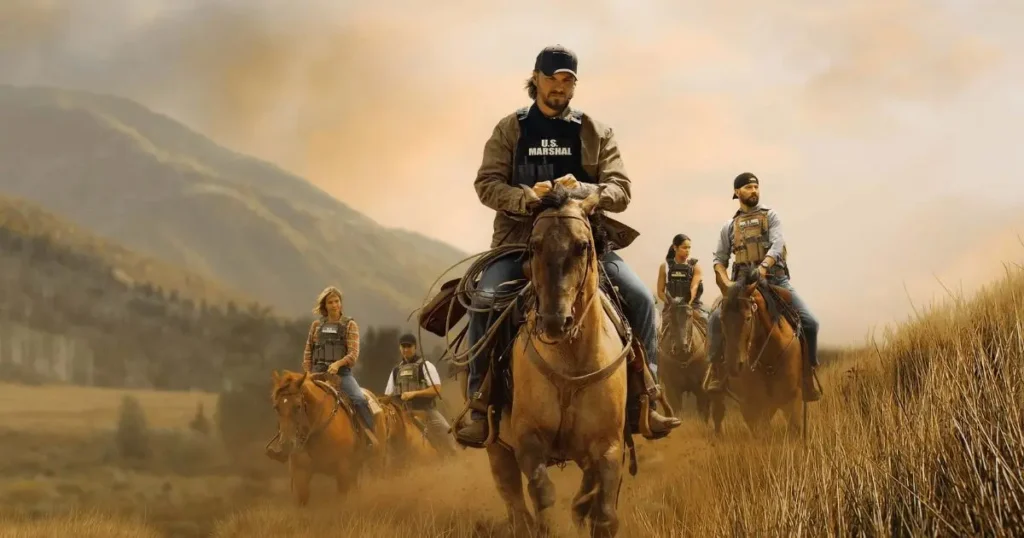
The Yellowstone television universe is no stranger to growth, with prequels and sequels as well as offshoots of a more local nature all part of the mix. But within that expanse, CBS’s Marshals is quietly executing a significant shift in direction. The first season was defined by Luke Grimes’ brooding re-emergence as Kayce Dutton, which gave the show its narrative moorings; heading into the second season, however, viewers can expect a move away from such a narrow concentration to something of a more open ensemble piece.
In its debut Marshals established its mark on CBS’s otherwise procedural-heavy schedule. It was an easy enough watch for those navigating the transition from the ranch, inasmuch as it could marry Taylor Sheridan’s brand of western to the old case-of-the-week format. There was a cost to that kind of accommodation though. An overabundance of episodic investigation placed the onus of drama squarely on Kayce, sidelining others in the process. It was a way of paying homage to his place in the Dutton story but at times it meant the show did not get the most out of its supporting players.
What one sees in the early going of Season 2 is an attempt to inject some breadth back into the proceedings. Developmental word has it the writers will be giving the ensemble more room to manoeuvre, delving into matters of personal import like the cancer Cal (Logan Marshall-Green) is up against, things that cannot be confined to the badge. By doing so, the series places less stock in a formulaic template and spreading the dramatic load around.
Breaking Free from the Shadow of the Ranch
For a franchise of this ilk to endure it is necessary to execute such a stylistic break. A legacy figure in the mould of Kayce Dutton will draw initial viewers, but if a spin-off is to have a voice of its own it can ill afford to be propped up on the nostalgia of the original. Marshals has shown it can do the numbers for the network, but to get beyond what Yellowstone leaves in its shadow, it must become a law-enforcement ensemble in every sense, not just an appendage of a cowboy drama.
With a wider scope the writers are free to examine the socio-political side of contemporary Montana, not just the family troubles of the Duttons. Allowing characters some distance from Kayce invites a level of world-building and conflict in the telling that would not otherwise be there. A more communal mode of storytelling, should Season 2 live up to it, would turn Marshals into a solid fixture in primetime rather than a bridge.
Redefining Network Westerns for a New Era
Adapting prestige IP into something for the broadcast model presents a delicate balance. You are on a tightrope when you have to condense the moral ambiguity and serialized violence of a Yellowstone-type offering. Too much of the same procedure and you alienate the fans of the epic; too much of a serialized bent and you lose the casual viewer.
Marshals seems to have found its balance in the understanding that the humanity of the men in uniform and the western setting are what constitutes good television. In adopting a narrative with more of a multi-faceted perspective, the series is proving that to do right by the ranch’s legacy one has to look beyond its fences to the world on the other side.