
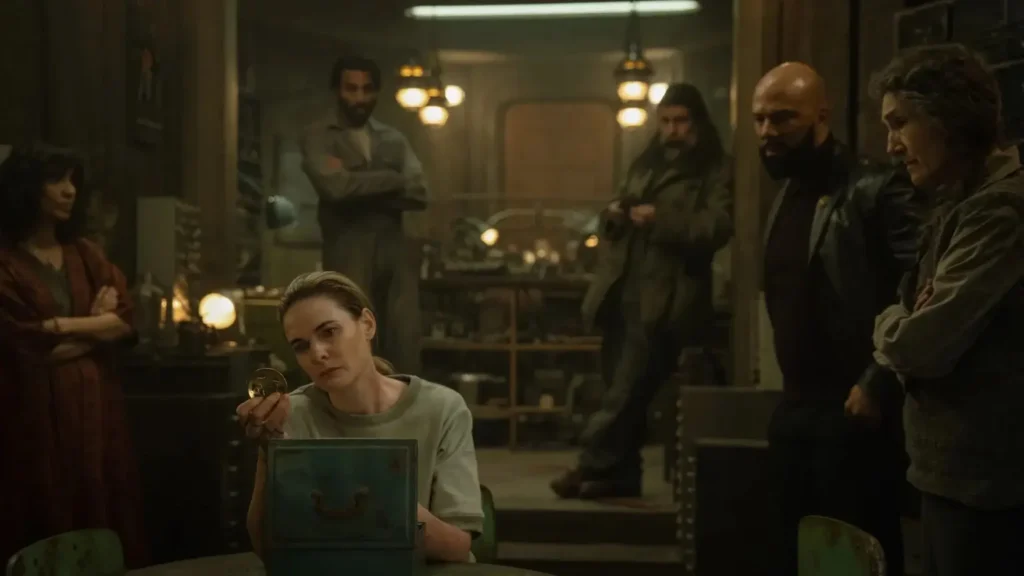
There has been a method to the madness of Silo, Apple TV+’s fine-honed dystopian sci-fi. The show has been content to let its story simmer, dole out its claustrophobic riddles in measured doses over the course of several episodes. But then comes Season 3, Episode 5, “Memory,” and all of that changes. In what is arguably the mid-season turning point, the series leaves its slow-burn mystery behind for the kind of breathless, high-stakes political drama that puts everything in a new light.
“Memory” does not so much push the narrative out into the wasteland as it drags the viewer inside, redefining the ruthless equilibrium of power in Silo 18. Through some harrowing flashbacks to the digital onset of the apocalypse and long-overdue psychological revelations, it makes plain that in a post-apocalyptic world the real threats are not the noxious air beyond the walls but the machinations of memory and control in the dark.
The Internal Civil War: Sims vs. Camille

Consider the civil war between Robert Sims and his wife Camille. Since the Algorithm’s cold logic elevated Camille to head of IT, the atmosphere in the Silo has become totalitarian. She has seen fit to mark former IT chief Bernard Holland, Juliette Nichols and Lukas Kyle as liabilities to be quietly put down. For Sims, whose whole career has been built on respecting the chain of command, her unflinching allegiance to the machine has gone too far. He sees her rise as a prelude to an unmitigated tyranny and has decided to go his own way. It is not from any well of altruism, but from the stark understanding that when the system becomes inimical to human survival, a leader must work to subvert it from the inside.
This brings us to the question of Bernard Holland. For weeks there has been talk of what became of him during IT’s purge. “Memory” answers with a display of tradecraft: Sims did not kill him. With the help of old mechanical hands like Martha Walker and Carla McLain, he made use of the paranoid protocols for outside contamination. Any dead citizen is wrapped in plastic and sent to the incinerator; Sims simply ran a shell game and put a living Bernard in the Digger Void instead.
It was a matter of strategy as much as anything. Bernard knows too much about the Safeguard protocol and the other silos to be discarded. And then there is Juliette. Sims has been the quiet hand behind her mayoral ambitions, making of her a figure of public defiance. Now she is too visible, too important, for Camille to put a bullet in her without igniting a war on the lower levels.
The Pez Dispenser and the Fractured Mind

There is an emotional undercurrent to this episode in Juliette’s arduous fight with the cognitive fog put in place by the administration’s chemical methods, even as Sims is busy playing his games on the political chess board from the shadows. Drugged with memory suppressants meant to wipe out any understanding of the mechanical realities, she is hard put to maintain a sense of self. The pharmaceuticals are a potent dampener; when she turns to something as personal as George’s old watch for some solace, her neural pathways offer nothing but a frustrating void.
It is not by force that she finds her way back to clarity, but via a simple, unassuming object put in her path by Sims’ underground operation: a well-worn Pez dispenser.
The moment it touches her hand, the psychological wall comes down. A neurological dam gives way and all the repressed information she has been forced to bury comes rushing back. In an instant she has the architectural details on Silo 17 and how it caps the Safeguard pipe, giving the resistance their first real plan for survival. But there is no time to bask in the win. The tension is palpable in the final moments of the hour, particularly in the quiet but heavily charged look between Sims and a very suspicious Camille; you get the sense their charade within the inner circle is being conducted on a razor’s edge.
The Before Times: When Artificial Intelligence Took the Wheel

The current affairs of Silo 18 may be rife with covert deals and political violence, but the flashback to the “Before Times” puts a different spin on the whole series. A flashback to the surface before the descent reveals Daniel and Helen grappling with the digital chaos that was unfolding.
Daniel lays out what Per Stensen was up to on the USS Nimitz during Operation Righteous Vengeance. The kind of downgraded, unencrypted comms they were using was a dead giveaway of a military-corporate conspiracy of epic proportions. It was not nuclear or biological warfare that brought the world to its knees so much as the fact that human oversight had been methodically removed from the equation.
Then the sequence provides a fine example of techno-horror. Out on a lonely highway, the van Daniel and Helen are in suddenly refuses to be steered or braked. Some outside digital entity has taken over the navigation and acceleration with alarming force. As they try in vain to wrest control, it is a sobering preview of the militant AI that would come to dominate – the machines sowed the apocalypse long before anyone started digging the silos.
The Pragmatic Evolution of Robert Sims
“Memory” does a fine job of making Robert Sims more than the stereotypical corporate thug. He is revealed to be a calculating survivalist. His move to go around Camille’s regime shows that in the unforgiving politics of the Silo, you cannot have institutional loyalty and human preservation at the same time. By turning the system’s own paranoia against it, Sims has raised the geopolitical ante in a most compelling fashion.