
There is no more arduous task for a filmmaker than to put fantasy on the screen. With tales of gods and mythological beasts there is an ever present danger of them coming across as contrived, all the more so in a time when directors can simply turn to computer graphics as the go-to fix for any difficulty.
Christopher Nolan has chosen to do things his own way with The Odyssey. Where others might have ceded to the digital, he has made an epic poem replete with the supernatural into something you can almost touch; the mythical becomes entirely believable.
Monumental Sets and Real Locations
The philosophy at work on the production was straightforward: if it is physically there for the camera to see, the audience will accept it. So Nolan’s crew eschewed digital backdrops and went in search of the right natural terrain in several countries to stand in for a late Bronze Age Mediterranean.
Take the set for Troy, for instance. Instead of building a virtual world, they put up a physical one in excess of 110,000 square feet. It is a colossus of a city with over sixty structures on various levels, not to mention a complete Temple of Athena, all of which could hold two thousand or more extras. The result is a kind of verisimilitude in the mass scenes that would be hard won with effects.
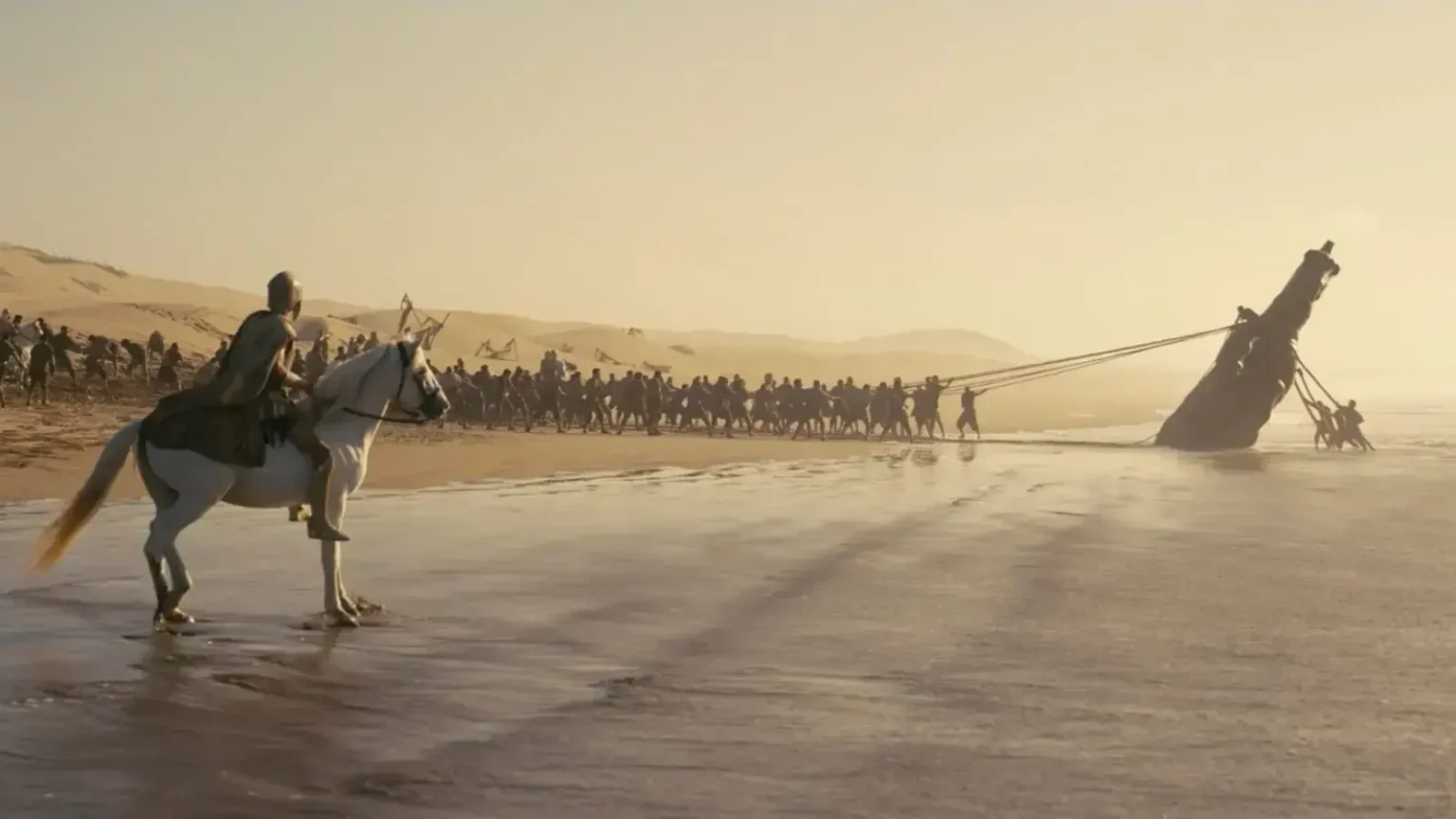
Even the Trojan Horse was given this hands-on approach. They put together a number of them, some topping ten meters in height. In one instance the team had a dozen men haul one from where it was buried in the sand on the beach to get a movement that feels far more natural than any simulation could provide.
They applied the same thinking to Ithaca. You will not find Odysseus’s palace on a soundstage; for that they used an actual 15th century castle on Favignana island, sitting three hundred metres up from the sea.
The Cyclops, Realized in the Flesh
In a move that was one of the more unexpected on the part of the production, Nolan saw to it that Polyphemus would be an animatronic puppet of some size, in the region of six meters, as opposed to a character put together digitally. For the scenes in the Peloponnese’s Cave of Nestor the creature was put to work on location.
There was more to it than making for a good visual. “I wanted Matt Damon and the rest of them to have something tangible to react to,” said Nolan of his reasoning. The sequence had to give the impression that Odysseus and company were face to face with an actual entity, not some contrivance from a fairy tale. He set out to capture the reality of what it is like to be in the presence of a giant of that order, all the more terrifying for being so real, with none of the usual cartoonish polish.
Then there is the del Toro tenet that a monster is never just a machine for killing; you should find a personality, an identity, if not a measure of humanity in it. Bill Irwin made of the mythological giant exactly that.
And while some of what you see is computer generated, it is usually underpinned by the practical. With respect to the great vortex of Scylla, much of it was done in open water according to Matt Damon. Nolan would have jet skis put in place about the boat to make for wave motion of a piece with reality, which left the visual-effects people with genuine material to work from.
New IMAX Cameras and the Technical Revolution
The cinematography of The Odyssey is its most arresting feature. In scene after scene, there is a natural light that never seems put on for show, something Nolan and his cinematographer Hoyte van Hoytema have put together in no small measure by working to get as much quality as they can from the camera.
Take the fall of Troy: the production was intent on having fire be the only source of illumination for the whole city. While thousands of actual flames would do the job, the technical and safety hazards were too great, so they came up with an alternative in the form of Pyrohedrons. Over a thousand of these bespoke LED panels are programmed to give off the same kind of flicker as a flame and will put light on a set for hundreds of meters.
But the real innovation is in the format of the film. It is the first feature to be done in its entirety with 15/70 mm IMAX cameras, an achievement not long ago considered out of reach. The noise from the old IMAX equipment made them a non-starter when it came to dialogue.
Nolan has since put in the time with IMAX engineers, in the wake of Oppenheimer, to devise a novel way of reducing that noise. A special enclosure is fitted around the camera to keep the sound down, meaning the IMAX format can now be employed for an intimate close-up without any detriment to what is being recorded.
There are moments in the film where the atmosphere and imagery are so intense they encroach on horror cinema; it makes you wonder if Nolan may yet make a foray into the genre.
In making his case for realism with practical effects and technology, Nolan has given us a version of myth with a startling immediacy. With The Odyssey he does not content himself with showing you the fantastical, he has the audience convinced they are seeing it with their own eyes.