
Few would dispute that the sprawling narrative world put together by George R.R. Martin is rife with the kind of obscure lore and old mysteries that have had fans in a tangle for years. Case in point: within the Game of Thrones fandom, there has been no more persistent debate than over where Daenerys Targaryen’s three dragon eggs came from at the outset of her crossing of the Narrow Sea.
Up until now, Martin has left the matter suitably ambiguous in his companion piece Fire & Blood, but the television version of the story is making a move to put some order to it. The latest arc of House of the Dragon is wading into one of the source material’s better fan theories, in the process filling in a historical void in the Targaryen line and giving the audience something to tie back to the original series.
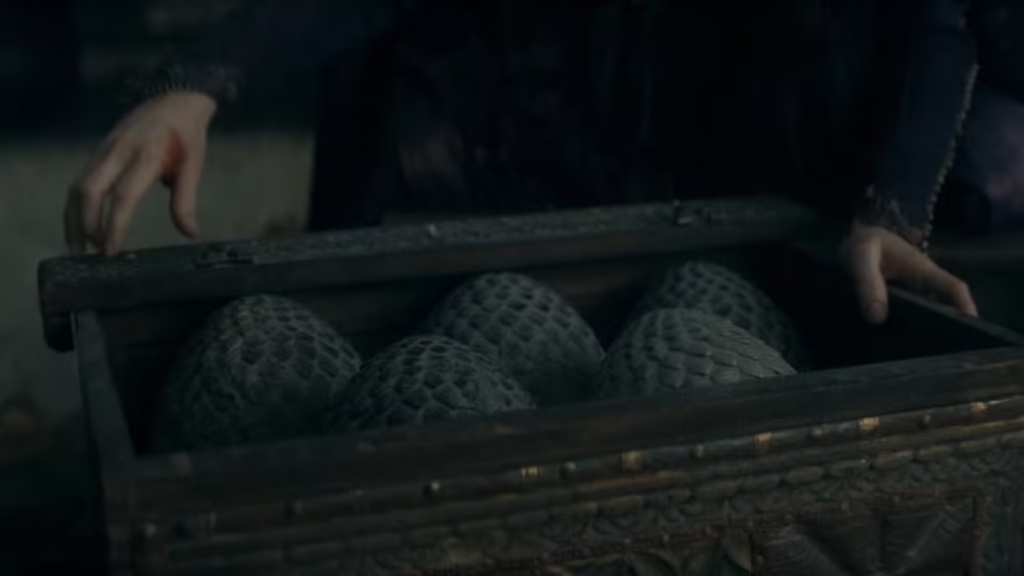
Consider the goings on at Harrenhal. This place has been a wellspring of dark magic and psychological strain this season, and its cursed stone walls are now the setting for a key moment when Alys Rivers puts a set of unhatched dragon eggs before Prince Aemond. They have been held in the tightest of secrecy. The show makes clear these clutches are the work of Dreamfyre, the silver-blue dragon who was Helaena’s mount and once ridden by Queen Rhaena.
Book readers and those steeped in the lore have long made the case for Dreamfyre as the likely mother of Drogon and his siblings. By having these particular eggs surface at Harrenhal, the programme gives visual weight to that idea. In the written record, Elissa Farman is said to have spirited away similar eggs to the Sealord of Braavos; by making the eggs part of the political machinations of the Dance of the Dragons, the series is laying the groundwork for such an exodus.
The writers may not be under any obligation to spell it out for us, but the evidence they are putting on screen is too exact to put down to chance. Harrenhal is being recast as more than a military concern, but rather the cradle of what will become legend for the exiled queen centuries hence.
There is something to be said for a narrative that can reward an attentive viewer without putting off the casual fan. It is a quality that makes this show’s approach so effective. Too many prequel series seem intent on winking at the camera, cluttering their episodes with the kind of superficial Easter eggs that do nothing but break the viewer’s immersion. House of the Dragon is not in the habit of such things; it integrates its more obscure history into the very fabric of its characters’ political and emotional lives.
Take Aemond and his fixation on the eggs. It is a telling display of his need for military supremacy and a sense of divine right, using the trappings of what will be future dragonlords to mark his slide into paranoia. Or consider how Alys Rivers is employed to link the realm’s biological inheritance to the mysticism of Westeros. In doing so the programme shows it has as much interest in planting the seeds of some distant tragedy as in documenting the bloody civil war at hand.
You might wonder if the franchise will ever put an end to speculation over how those eggs made their way from Westeros to Pentos. But by turning deep-cut lore into a weapon and indulging the fandom’s theories, the show puts a reminder in front of audiences as to why Martin’s world is so compelling. The magic of Westeros is found in the unanswered questions as well as the fire and blood.