
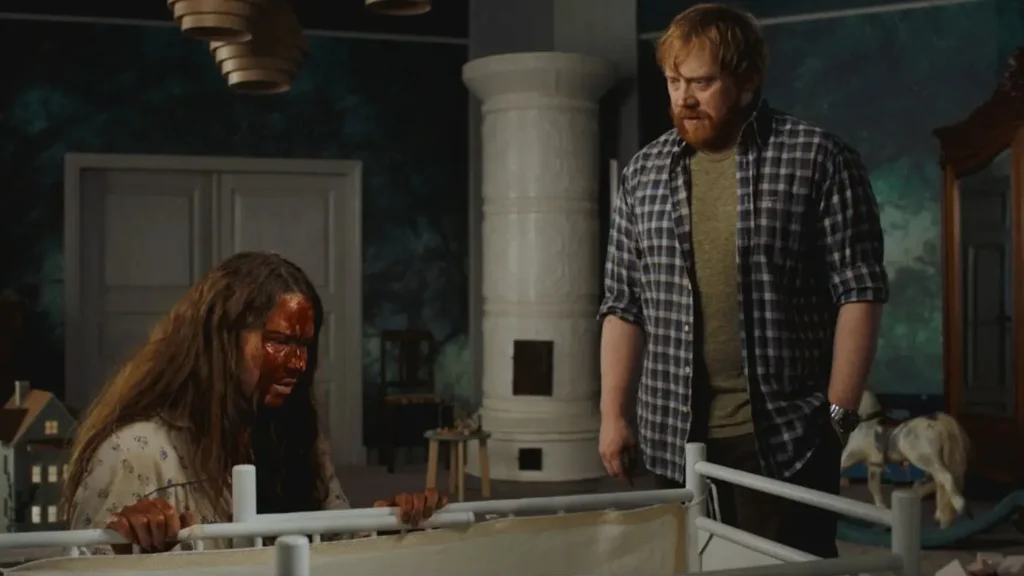
Hanna Bergholm, from Finland, directed the disturbing body-horror fairy tale Hatching. Her new movie, Nightborn, may be one of the most quietly disturbing horror movies of 2026. It has creature effects, folklore and physical decay but what makes it powerful is that it shows the darker, more shameful sides of becoming a mother, something that is rarely shown on screen.
The story follows a woman named Saga (Seidi Haarla) who wants to have a happy family with her husband Jon (Rupert Grint). Soon the promise of a new life turns to fear. But despite everyone around her telling her the baby is fine, Saga is increasingly certain her child is gravely ill. Her fears are dismissed, leaving her alone in a cycle of fear, doubt and obsession. The film is a blend of psychological horror, Finnish folklore, and family drama, exploring emotions such as fear, inadequacy, and the weight of social expectations that are difficult to address with civility.
Both the lead actress and director have spoken about how the material resonated with them. A written piece that openly showed the bad feelings that many moms have but don’t feel like they can talk about moved Haarla. To give those “forbidden” feelings a place to live was freeing. Bergholm, drawing from her own experience as a mother, wanted to examine the messy, hard, sometimes ugly side of parental love that most stories try to clean up or ignore.
The movie shows how upset Saga gets as her mental health deteriorates. The family house she and Jon are fixing up starts to fall apart. The trolls and the forest around her become tangible images of her greatest fears. Nightborn keeps you guessing, like The Babadook, The First Omen or Servant. Is the child the real threat or are the people who refuse to believe the mother? Bergholm’s reliance on practical effects, prosthetic makeup, and physical transformation over digital spectacle lends the horror a tactile, grounded quality that keeps the drama of people at the heart of it.
In the end, maybe the scariest thing in Nightborn isn’t the monster in the woods or the decay in the house. The constant pressure of being a “perfect mother” and the guilt that comes with not being able to see herself in that impossible image.
Nightborn may be scarier than a lot of other films in the same genre because it doesn’t treat maternal ambivalence as a temporary problem that will fix itself with enough love. Movies like Rosemary’s Baby, The Babadook, and Hereditary, all use motherhood as a source of fear. However, the mother’s fear is often supported by a clear external evil that keeps the story in order. Bergholm seems more interested in the idea that the fear itself might be the point: the feeling of aloneness that comes after a woman’s instincts are ignored and the gradual loss of self that follows. The supernatural is rooted in Finnish folklore and the actual decay of a family home. This provides the movie’s themes with a physical form without ever letting the audience off the hook completely.
It’s also interesting to me that Rupert Grint was cast in this role. He is known to portray characters who are loyal and honest about their feelings. In this movie, he plays a husband who, at least in the beginning, is like a chorus of reassurance that Saga doesn’t hear. That makes the horror of being disbelieved even worse. Nightborn doesn’t have many jump scares. Instead, it’s about the quiet fear of knowing the people closest to you might not be able or willing to see what you see. We still see a lot of idealized images of parents, so a movie that shows shame, doubt and the fear of being a “bad” mother seems not only right for the time, but necessary. It may or may not be the scariest horror film of 2026, depending on how well it is made, but its aims already make it one of the more thoughtful horror films of the year.