
One could call Christopher Nolan’s The Odyssey a blockbuster colossus, and the film has certainly made its mark as such. Yet it would be a mistake to see it as a simple re-telling of Homer; that is to miss the point of its thematic construction altogether. Nolan does not put forward a schoolbook version of Odysseus making his way back to Ithaca. He has built something more in the nature of a modern psychological study, one that is less swashbuckling adventure and more a hard-edged look at the kind of trauma left in the wake of war. Where there might have been clean mythic heroism, the film is preoccupied with the toxic moral residue of Troy, and an Odysseus who is no mere wily wanderer but a veteran bearing the scars of violence.
Nolan gives this a certain suffocating historical heft by looking well past what is in the Odyssey proper and drawing on the wider Trojan Cycle. The narrative is put down in the blood debts and generational sins that were there before the first spear was cast. A particularly unquiet thread from the house of Atreus hovers over the proceedings like a phantom, a reminder of command and moral complicity.
At the heart of all that pre-Trojan gloom is the matter of Iphigenia, which puts a morbid pall on the whole Greek venture. In the old tradition, the Achaean fleet is at Aulis ready for Troy when Artemis sends winds they cannot overcome. Calchas, the seer, makes plain to the high command the will of the gods: unless Agamemnon offers up his eldest daughter to the goddess, the war will be stillborn. It is a harrowing piece of business. Under the ruse of a marriage to Achilles, the king coaxes Iphigenia from her home, holding out the prospect of happiness before he brings her to the altar. In so doing, he puts his crown and political standing above his own child, and the Trojan War is set in motion not by some act of valour but by a domestic killing.
You can find all manner of narrative variants in the myth, of course. Aeschylus has Iphigenia die under the knife to the ruin of her mother, Clytemnestra, and to begin a cycle of assassinations. Then there are the later, more merciful versions where Artemis puts a deer in her stead at the last moment and Iphigenia is spirited off to Tauris to be a priestess, eventually having a tense, unacknowledged reunion with her brother Orestes when he comes calling on a hopeless errand.
Nolan is clearly in dialogue with the likes of Aeschylus and Euripides here, taking his cue from their masterpieces to show the Trojan War as an inescapable tragedy rooted in original sin. Iphigenia becomes the war’s “moral ghost.” When the campaign is founded on a father’s betrayal of an innocent child, the whole endeavour is spiritually tainted. And so Odysseus’s trek across those monster-haunted waters is recast as a form of penance, a way of working off a moral debt that predates his time with a sword. How could any man come back from the ashes of Troy and remain innocent?
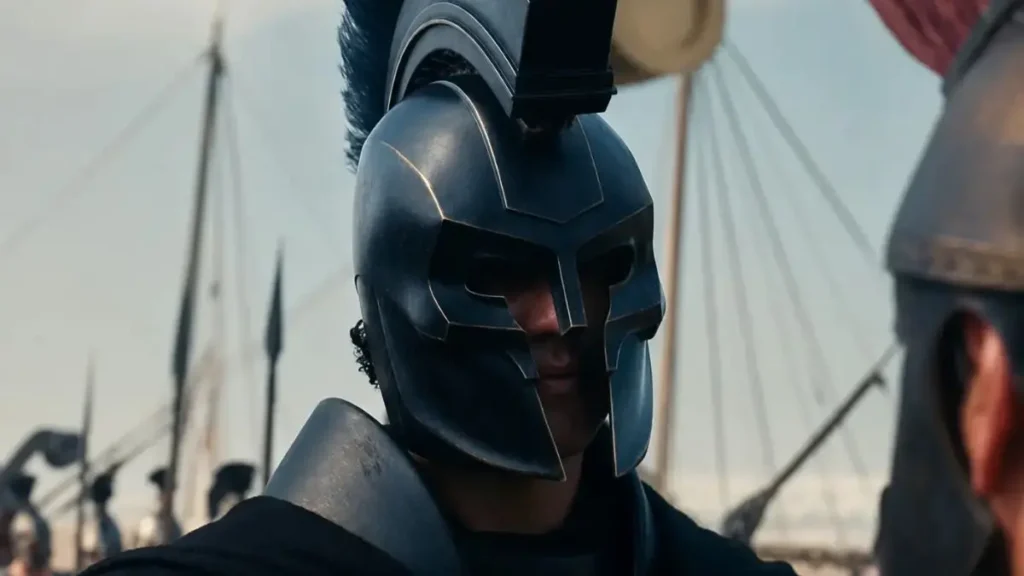
You can read this sense of guilt in the visuals, too. Nolan’s Agamemnon is no glorified monarch of Mycenae but an imposing, spectral presence in black armour that seems to drink the light, his features often lost in the shadows. He is the personification of the burden of command. By making this sacrifice part of the story’s fabric, Nolan is saying the rot was there at Troy long before the wooden horse. Nolan is saying the rot was there at Troy long before the wooden horse. It strips the narrative of simple heroism, framing ancient myth as a mirror to the inescapable cycles of human violence rather than a series of flashy monster encounters.
Nolan has a way of turning the old homecoming story on its head; by putting Iphigenia’s sacrifice at the heart of the matter, he makes it the moral driver of the piece and in doing so produces a rather haunting meditation on complicity. The film is at its most brilliant when it withholds any easy absolution for the hero, compelling an audience to look at what is unholy underpinning our national myths. The Odyssey, then, is no celebratory pageant for Troy’s conquerors. It is a stark and timeless reflection of the violence that is part of the human condition.