
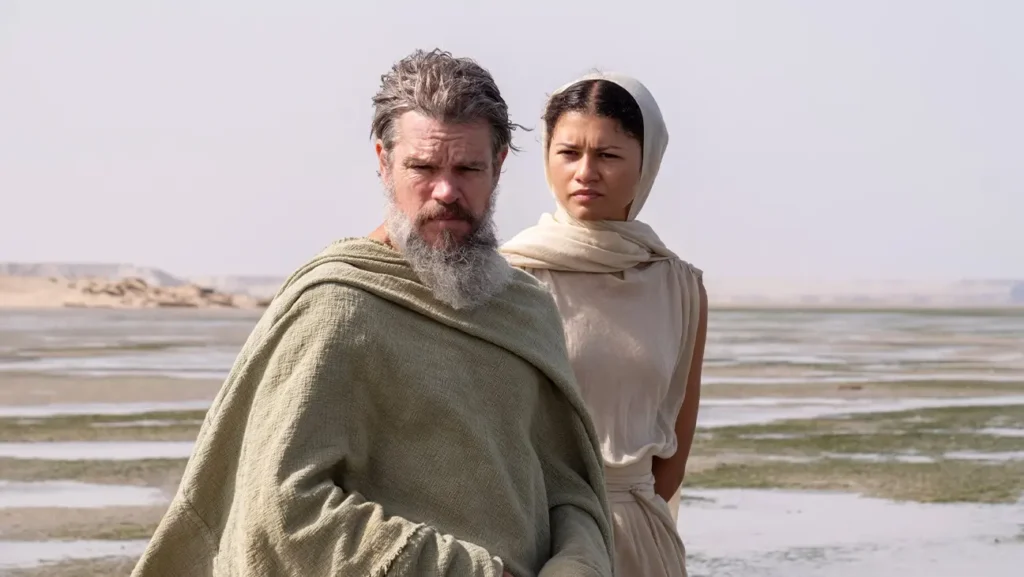
There was no shortage of conjecture among industry observers when Christopher Nolan, the legendary filmmaker, set his sights on Homer’s old epic. But the nature of the dispute that would follow was not what most had in mind; it was to become a veritable literary crossfire between one of America’s finest living writers and a leading classical translator from across the pond.
The powder keg was lit with the premiere of The Odyssey, Nolan’s latest blockbuster. The film may have been the talk of the town and a box office juggernaut around the world, but it also attracted the ire of Emily Wilson. The classicist and well-regarded translator put forward a withering public critique of the movie. In a review that made waves in both the cinema and literary worlds, Wilson was uncharacteristically blunt: she said she would be “ashamed to have written any part of this script.” She found the dialogue wanting and the whole structure a bit of a gimmick, faulting the film for being devoid of the psychological and political heft one would expect.
Then Joyce Carol Oates made her move. With her formidable literary standing and reputation for speaking her mind, Oates waded into the matter to offer a pointed defense of Nolan and the art of adaptation in general.
A Clash Over Artistic Interpretation
Oates was openly perplexed by the vitriol on display. In the course of public debate she made her case that a translator, whose vocation is to serve a foundational text, ought to show a good deal more collegiality to an artist working in good faith. As for Nolan, she saw no reason to question his right to put a modern spin on some of the great archetypes of mythic history; there are no hard and fast rules against such re-envisioning.
Her remarks were enough to set off a cultural row online. You could draw a line down the middle of the commentators and scholars: some were lauding Wilson for applying proper classical rigour to a Hollywood product, while others, with Oates at their side, were having none of the translator’s unmerited hostility toward an endeavour meant to bring these old myths to a wider audience.
High Art Meets the Hollywood Blockbuster
There is an old tension at the core of this public row, one that has to do with where academic integrity ends and creative reinvention begins. On one side you have a translator such as Wilson, who will be scrupulous in her efforts to preserve the meter, language and cultural underpinnings of ancient Greek verse. Then there is a filmmaker like Nolan, whose stock in trade is the sort of sensory immersion and temporal play that makes for grand spectacle on an IMAX screen, not in a lecture hall.
But Oates is correct to suggest these two need not be at odds. The arts have been powered by re-imaginings since the time of the Greeks, when it was common for a playwright to put his own spin on a myth for the sake of the audience of the day. In coming to Nolan’s defence, Oates made plain what is really at stake in artistic evolution: an adaptation is no slight on the past so much as a way of continuing the conversation with it.
In the end, it is hard not to see this as evidence that our foundational myths are as lively and divisive as they have always been. The intensity of the argument, be it in support of Wilson’s insistence on classical rigour or Oates’s case for a more cinematic approach, is what makes the point: Homer’s Odyssey is no dead letter but a living document. Then there is Nolan’s film; it does not put the original to rest so much as it bears witness to its immortality. It is a reminder that even after three millennia, such old stories can still set off the kind of cultural discourse we see here.
Source: x.com