

There is an unrelenting quality to the third season of Silo, Apple TV+’s dystopian flagship; a systemic paranoia and claustrophobia that has come to define it. Episode 4, “Whatever You Do, Don’t Go Home”, is no exception. It is a lean, propulsive affair and in many ways a masterclass in building tension. By way of a cat-and-mouse game played out in the underbelly of Silo 18 and some telling history from the “Before Times,” the hour manages to strip away institutional deceptions and set the stage for something of a seismic shift in the story.
An exhaustive recap and analysis follows for those wishing to put the pieces together, from the structural twists and narrow escapes to the final frame.
The Medical Ward Escape: Outsmarting the Algorithm
Things pick up in earnest where the last chapter left off. The Algorithm has given Camille Sims (Alexandria Riley) a simple directive: put Juliette Nichols (Rebecca Ferguson) down and make it look like a heroic casualty so as not to trigger a system-wide reset. Camille readies herself for the task with a cold sense of administrative duty, seeing it as the only way to preserve the peace in Silo 18.
But the Silo’s authoritarian grip has its vulnerabilities, and one shows itself in Nurse Amy (Jacqueline Berces). In a scene of sharp choreography, Amy defies Camille, putting security in their place and allowing a memory-addled Juliette to slip out of the ward before any harm can be done.
From there it is a matter of high-speed survival. Juliette has to trust her instincts and whatever memories are coming back to her as she putsterers through stairwells and vents to put distance between herself and security. She is complicated by an encounter with Robert Sims (Common) in the lower levels. He makes a move to stop her, which leaves one to wonder if he is following his wife’s lead or has his own double-cross in mind, but Juliette evades him and heads for her mechanical roots. Others, such as Shirley Milner (Remmie Milner), will risk their own skins to see the former mechanic kept from Judicial and IT.
Read Also: ‘The Chi’ Series Finale Breakdown: How Lena Waithe’s South Side Drama Wrapped Its Run
The Flashbacks: Unraveling the Before Times
Even as Juliette’s present-day existence is tenuous, we are taken back to the historical record to see what drove humanity below ground. Congressman Daniel Keene and Helen Drew are at the heart of an investigation that is becoming increasingly paranoid in its pursuit of unencrypted communications and the truth of the global catastrophe.
Their work uncovers a rather chilling parallel. The behind-the-scenes machinations of politicians in a dying world have a direct line to the algorithmic cage the Silo’s citizens inhabit today. One cannot miss that the shadowy interests of the past are the ideological forebears of the IT department and the Algorithm that rule the lower levels now. It was never merely a refuge, but an experiment in continuity meant to stifle independent thought for good.
Ending Explained: The Truth Behind the Curtain
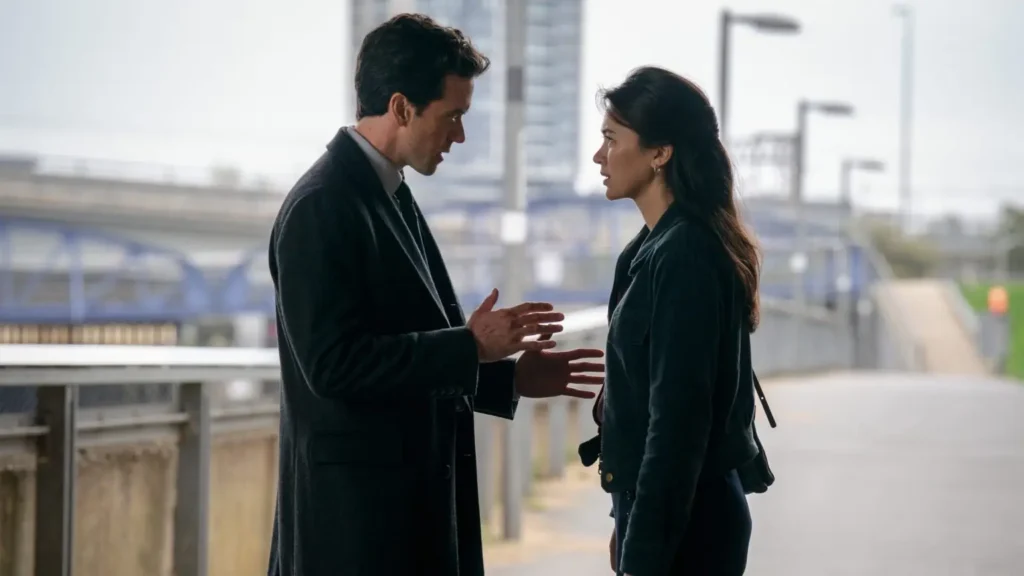
In the end, Juliette’s flight takes her well beyond the Digger Void and into the restricted tier of Silo 18. Jullette is braced for solitude or some other snare, but what she comes across defies all expectation.
There is no emptiness to the chamber; rather, a faint sound carries to her ears, one she can put no other name to: the unmistakable rattle of a human cough.
She makes her way to the edge of the hidden space and draws back a heavy curtain of makeshift material. On the other side is none other than Bernard Holland (Tim Robbins), her former arch-nemesis and the man who once ran IT. He is in an improvised bed set in the shadows, frail and badly burned. Lifting his head, he offers a greeting that is as chilling as it is raspy. “Hello, Juliette.”
The news of Bernard’s survival is a shock that rewrites the power dynamic of the series in one stroke. By the end of Season 2, he was thought to have been taken by the airlock cleaning fire with Juliette, trade reports having put the public at ease with the story of his charred remains being fed to the incinerator. His being here is a clear indication of Robert Sims’ handiwork; the former head of IT was probably kept alive and put out of sight under the silo rather than put to death. One has to wonder if this ruse is evidence of a fracture in the upper ranks, with even the enforcers making quiet arrangements to hedge against the Algorithm.
For two seasons, Bernard was the face of the IT department’s oppressive doctrine, the arbiter who would go to any length to keep the mechanical order and the truth of the outside world at bay. To find him like this, in a damp basement and without his authority, is a complete inversion. It speaks to the cruelty of the system, which will see its own leaders as expendable should they lose control.
Now that he is safely sequestered in the dark, Bernard’s insider knowledge of the silo’s administration is the one thing Juliette needs to tear the system apart from within, provided she can get him to open up. He has had months to think on the lies he used to protect while the new regime took over. He knows the origin of the silo, the Digger’s true purpose and where IT’s surveillance is weak. The question is whether he will be forthcoming or make of Juliette a pawn in some bitter revenge on Camille and Sims.
It is an uneasy alliance of necessity. She came in here running from an execution order and now finds herself looking the architect of her past troubles in the eye. In the tight quarters of the silo, old adversaries are left to decide if they will destroy one another or put their combined wits to work to bring the whole operation down.