
In the penultimate episode of its third season, House of the Dragon comes to a head at a time when the series has struggled to maintain its narrative momentum. “The Dragon in Winter”, as Episode 7 is officially titled, is an hour that after an overwrought start and some unevenness in between, restores focus to the show’s dragons, its most compelling and thematically sound feature. The result is an episode of considerable grip and effectiveness, if one finds it frustrating at times; it is a reminder of what this prequel is for. These are not just instruments of royal indulgence or weapons to be brandished. They are their own unpredictable entity, a force that has a way of showing up the Targaryens’ self-destructive ambitions and the tenuousness of family ties, not to mention how much control humans think they have.
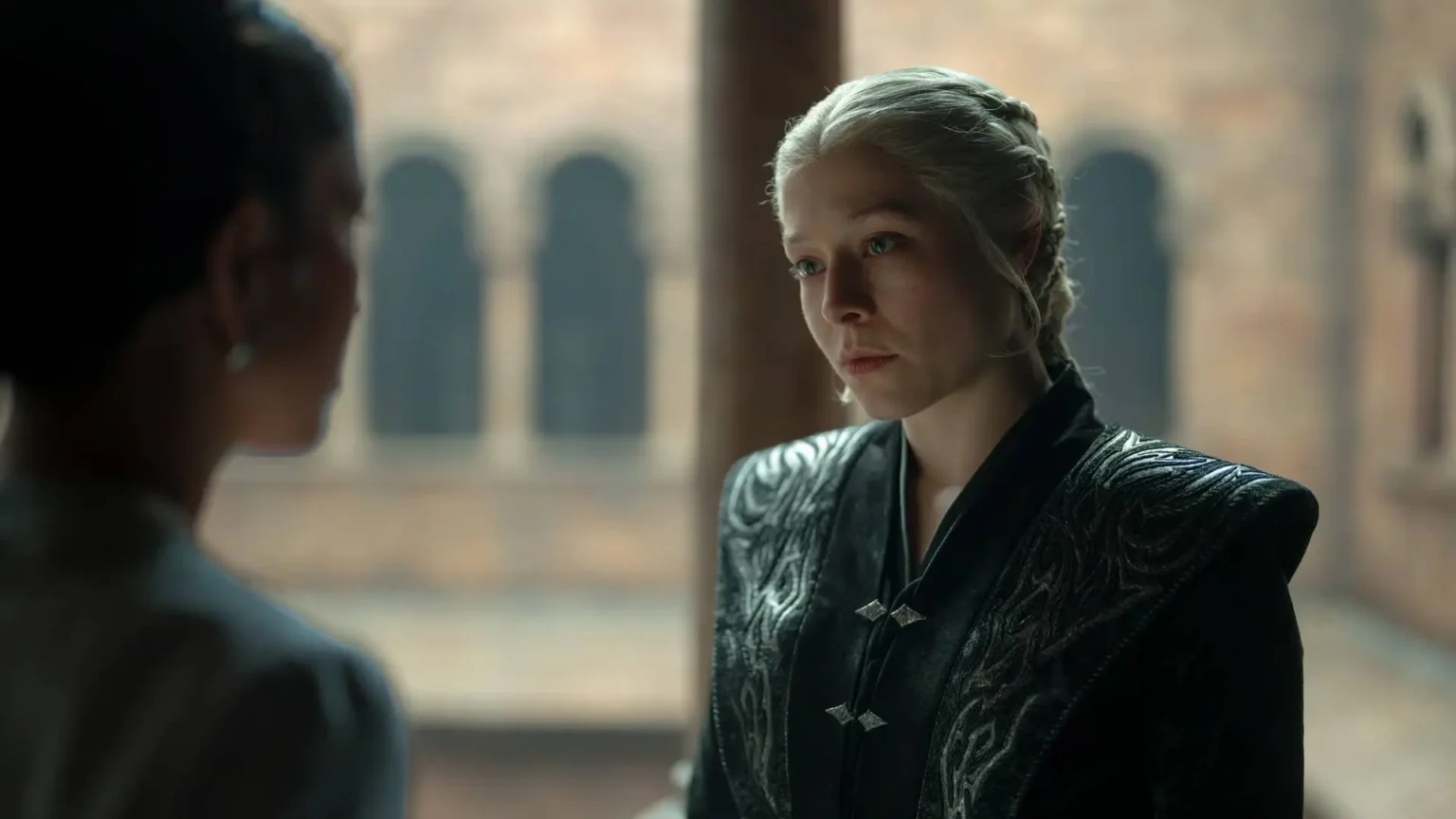
The episode opens with Helaena Targaryen, found in the throes of a prophetic fit and unable to rest as old events or visions intrude on her sleep. What follows with Rhaenyra is a subdued affair but perhaps the most revealing of the season thus far. Rhaenyra wants to know from her half-sister what became of her riding Dreamfyre. “Too much,” Helaena says, which is answer enough. Then Rhaenyra wonders if the bond with the dragons changes a person and Helaena challenges her to ask herself, whether all the dragons at her disposal have left Rhaenyra unaltered. One can sense the hollowness of Rhaenyra’s protestations as the episode wears on. The Realm’s Delight of yore is now more of a reactive sort, making choices for the sake of power without any thought of stability, and in doing so she seems to create more distance between herself and others.
One sees it in how Rhaenyra deals with the people about her. She is pointed with Helaena, bordering on cruel, at one point taking something from her sister’s hands in spite of the distress it causes. It is jarring to witness such impatience from Rhaenyra given that, as some have written, Helaena is among the only ones with any gentleness in a tale of violence and ambition. Rhaenyra is less patient with Daemon and more dependent on Mysaria. Finding out Daemon has seen to it that no one knows Rhaena is Sheepstealer’s rider is a further betrayal in a relationship run through with distrust and divergent aims. There is strength in the character work when Rhaenyra departs King’s Landing for answers, but it also serves to highlight the dearth of any real structure to her rule; personal whim has all but replaced the need for councils and advisors.
One Brutal Reckoning and Four Dragons
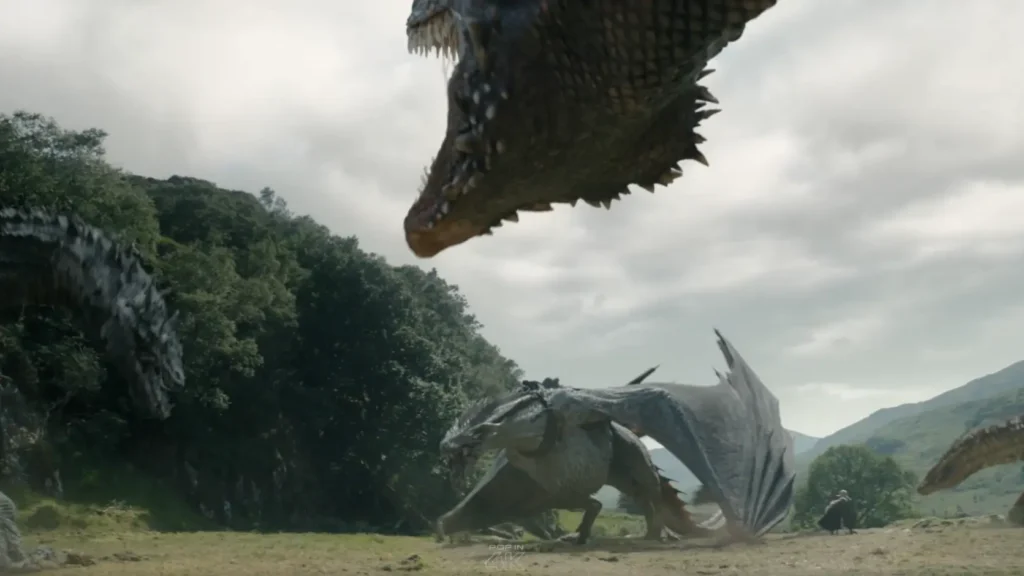
There is a certain chaos to the way the narrative draws Rhaena on Sheepstealer, Daemon with Caraxes, Rhaenyra on Syrax and Addam on Seasmoke in direct opposition. The multi-dragon encounter that forms the centre of the story is as unsettling an affair as the series has brought to the screen. The sequence lacks the disciplined structure of previous aerial engagements; the riders are for all intents and purposes without full command of the situation. Rhaena may have her bond but Sheepstealer is a wild dragon at heart, his ferocity and capriciousness something the more tamed beasts will not tolerate. Strategy gives way to instinct, orders are made and then disregarded. It is a melee that has the air of a brutal animal squabble rather than any kind of military precision.
When Daemon tells Caraxes to “Kill him” the words carry weight, one of the rare occasions a rider’s will is so readily heeded. But it is only after things have passed the point of control that the command is given. By the time it is over Sheepstealer is badly wounded and the humans left to their various states of shock. Rhaenyra opts to bring Rhaena to King’s Landing instead of meting out retribution on the spot, a move that could be read as either calculated or a matter of family ties; what she has in mind for the future is not so clear. In the end the scene makes plain what has been the case since Lucerys and Arrax were lost: that man’s dominion over a dragon is mostly pretence. They are independent creatures who will reflect a rider’s flaws and desires.
Then there is Aegon whose arc has become all the more engrossing. With Larys Strong and Tyland Lannister in tow following the goings on at Rook’s Rest, the injured king is hemmed in by those looking for the Master of Coin and the treasury gold he stashed away. Aegon does not make to run or put on airs, he simply asserts himself. Tom Glynn-Carney is memorable in the part as the king delivers a defiant word for his title and invites his hunters to do their worst. And right on cue comes Sunfyre, thought to be dead or done for, in a dramatic fashion. The dragon turns what would have been a defeat into a fiery victory and Aegon is relieved, vindicated and not a little manic about it, as if the mount’s survival is some sort of divine endorsement.
Sunfyre’s return is food for thought where the bond between the two is concerned. One can make a case for blood magic or the like as some have, but it is just as plausible the dragon was never killed, only underwent a period of recovery from its wounds to be able to act when its rider was threatened. What is undeniable is that Aegon is once again a person of consequence in the story. The physical toll and the reluctance of his first few seasons as king have been replaced by a confidence that is dangerous to say the least. If it is warranted or simply Targaryen self-mythologizing is an open question as the finale approaches.
Poisons, Betrayals and a Shaking of the Board
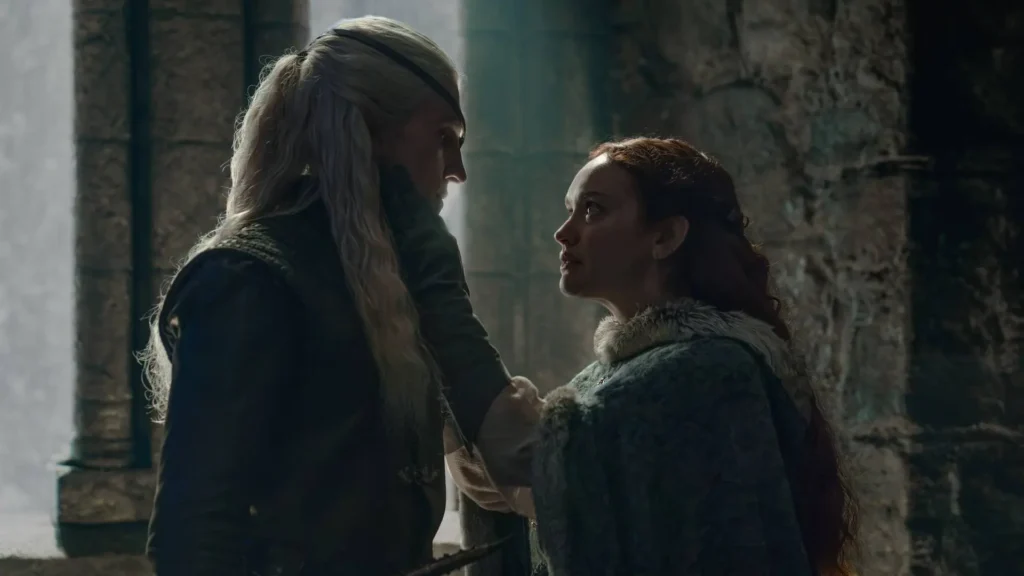
Lord Ormund Hightower has made himself one of the more unsettling and effective members of Team Green in political matters. With Corlys Velaryon already in his clutches, Ormund can leverage the Sea Snake as a means of pressuring the Velaryon forces; at the same time he is making an offer to Ulf that is part flattery, part promise of respect and material gain. One is struck by the cynicism of the way Ormund makes short work of the dragonseed. To be sure, Ulf has cause for grievance with Rhaenyra and Daemon, who have been wont to condescend to the new riders or impose restrictions on them. But Ormund has a finer hand in turning such grievances to his advantage than his adversaries do in tending to their own. The dragonseeds are sown with division and there will be no mistaking the uncertain loyalties that add to the tension of the coming Tumbleton affair.
A different kind of unease is in evidence at Harrenhal where the relationship between Aemond and Alys Rivers is evolving at a slow pace. Alys’s hold on Aemond is becoming more pronounced, not just in a romantic way but with a maternal edge to it too. Then Alicent makes an appearance and in trying to poison her son brings out something of a familial horror. It is true some have thought the Harrenhal storyline is at times disconnected from the war at large and overdone, but the poisoning does provide a more palpable sense of danger. For Aemond things are not as secure as he would like to think; in his view he is consolidating power, but in fact he is at the mercy of political, magical and maternal forces of which he has only an incomplete grasp.
There are weaknesses in the episode to be had. Unevenness in the visual direction of a few non-dragon scenes, dialogue that is all too familiar and character arcs that seem to be treading water are what one critic or another will note. If the finale does not introduce a new angle, Rhaenyra’s descent could well grow monotonous for all its thematic rightness. And with Alicent’s arc still so much in reaction as anything else, the protracted attention given to Harrenhal has tried the patience of those wanting to see the Riverlands campaign advance. Still, the dragon material is strong and there is a new vigour to Aegon that overshadows these flaws.
In the end Episode 7 is an adept shaking of the board. You see alliances put to the test and dragons of a mind to act on their own, key players with motivations that are now in plain sight or have taken on a dangerous cast. As for the finale, there is every indication of a marked escalation to come, not least in the fighting expected at Tumbleton and the matter of where the dragonriders’ true allegiances lie.
The Illusion of Control: Why Westeros Cannot Tame Its Own Destruction
One thing that sets House of the Dragon apart from most of its fantasy peers is the way it does not see dragons as dependable tools of policy but more akin to a natural disaster. The parent series and previous seasons have been wont to bask in the majesty of such creatures; here, especially in Episode 7, there is an undercurrent of their power to wreak havoc on a logic the riders can only partly fathom. Be it Sheepstealer making an example of the party or Sunfyre’s brutal response to Aegon, the humans are made to face up to the fact they are not necessarily the driving force of their narrative. It is all the more potent given how much ground the show has covered in the personal toll of the Dance, the grief and broken families and paranoia, before viewers are reminded that the means of destruction are beyond anyone’s complete command. In this lies a dramatic irony at once modern and classical, as we look on while the characters hold fast to the notion of shaping things for themselves, despite what the dragons and the historical weight they stand for will ultimately dictate.
Then there is the matter of the larger conflict being stoked by betrayals and neglect of a more intimate sort. Ulf’s defection comes of wanting some measure of autonomy and to be acknowledged, not out of any sweeping ideology. Rhaenyra is hard on Helaena from a place of desperation and an empathy worn down by pressure rather than cold strategy. As for Daemon, in hiding what Rhaena has done he is as much in the habit of secrecy, which erodes trust, as he is protective. Such failures on a human level are more conducive to the tragedy of it all than any one decision on the field of battle. Should the finale keep its eye on both these things, the dragon combat and the personal fissures that render it unavoidable, it could place Season 3 in a class of its own and make amends for the unevenness of episodes past. For now the pieces are moving. One is sure of only this: when the dragons settle matters, it will be left to the humans to deal with the aftermath, be it life or death.